
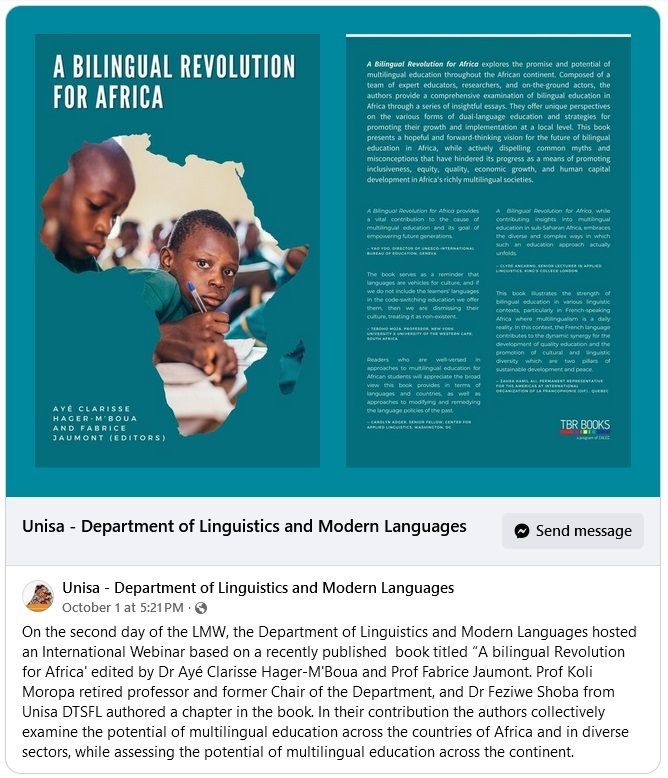
Thank you so much to the Department of Linguistics and Modern Languages at University of South Africa/Universiteit van Suid-Afrika (UNISA) for hosting the “A Bilingual Revolution for Africa” webinar. It was a great honor to be the keynote speaker and share insights alongside distinguished colleagues, including Prof. Sis Koli Moropa, who introduced me so graciously. The program highlighted key topics, from Dr. Maria J. Aaron’s presentation on improving education quality using African languages to Prof. Pierre De Galbert and Dr. Cornelius Wambi, Gulere’s exploration of multilingual teachers in multilingual classrooms. Djeneba Deby Bagayoko’s powerful talk on decolonial multilingual education through African mother tongues underscored the urgency of this dialogue.
I’m grateful for the opportunity to present this collective work edited with Ayé Clarisse Hager-M’Boua and engage in this important conversation. The discussions around multilingual education in Africa are crucial as we continue to examine the potential for linguistic diversity to drive educational transformation across the continent. Looking forward to more collaborative efforts in advancing these vital topics! The Center for the Advancement of Languages, Education, and Communities | University of South Africa/Universiteit van Suid-Afrika hashtag#africa hashtag#africanlanguages hashtag#language hashtag#education
Read the book here: https://lnkd.in/e9TBEarQ
About my presentation
This presentation, titled “A Bilingual Revolution for Africa: Embracing Multilingual Education for Sustainable Development,” explores the transformative potential of multilingual education in Africa. I introduce the argument that integrating native languages into education can preserve cultural heritage, improve academic success, and foster social cohesion. The presentation critiques the dominance of colonial languages in African education systems and advocates for the inclusion of indigenous languages to create a more equitable and inclusive educational environment.
Key topics include the impact of language on cultural identity, the benefits of decolonial multilingual education, and various bilingual education models across Africa. Examples from Côte d’Ivoire, Togo, and Kenya highlight the practical benefits of using mother tongues in classrooms. However, challenges such as societal resistance, misconceptions about language hierarchy, and a lack of resources are also acknowledged.
The conclusion calls for a shift in educational practices across Africa to embrace linguistic diversity, which is seen as essential for sustainable development. Critical thinking questions throughout encourage the audience to reflect on the role of community involvement, policy changes, and teacher training in advancing multilingual education. The presentation closes with a Q&A session, inviting further discussion on the practical implementation of these ideas.

