

French Heritage Language Education in the United States
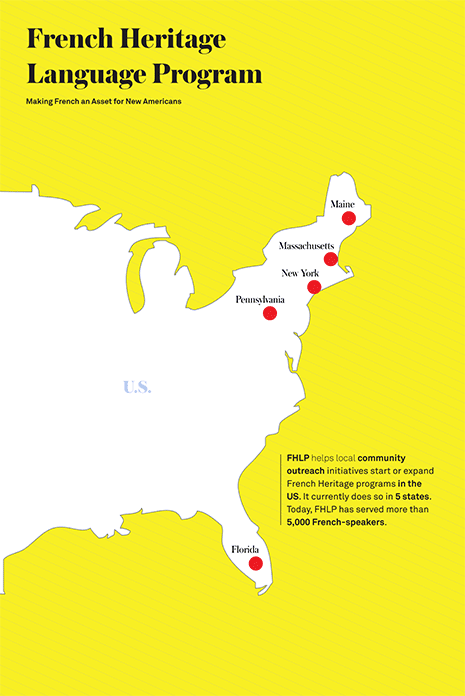
Promoting heritage language learning benefits all learners. This principle has resonated particularly well in the context of Boston, Washington DC, Los Angeles, San Francisco, and New York City’s French-speaking communities, where parents from diverse backgrounds and ethnic communities have become builders of French language educational opportunities for their children. In New York City these include European and Canadian expatriates in Manhattan and West Brooklyn, West Africans in Harlem and the Bronx, Haitians in East Queens and East Brooklyn, and North Africans in West Queens. This diversity in national origins, ethnicity, and socioeconomic status make the French case unique. Importantly, collaborations between multiple partners of different socioeconomic, racial, and ethnic backgrounds, from government agencies to parent organizations have motivated this transformation in French heritage language education.
Parent associations in particular have been of critical importance in promoting bilingual programs and language support and generating the larger community and governmental support necessary to sustain innovative programs in public schools. Thus, the combined efforts of multiple partners have helped to achieve a significant range of opportunities for French heritage speakers in New York and elsewhere. In order to create and develop linguistic opportunities that will strengthen the communities, French bilingual and heritage programs in urban centers and in traditionally French areas like Maine and Louisiana have required a solid tri-partite partnership – strong commitment from the schools, qualified teachers who understand the needs of heritage speakers, and ceaseless involvement from the parents at all levels. Thus, from the collaboration of various governmental and nongovernmental partners has emerged a rich landscape of opportunities for French heritage speakers in the United States. Successful community-led initiatives have been achieved throughthe willingness of different communities to work together – the fruit of multiple partners fromlocal, national, and international organizations; private foundations; parent groups; and education officials.
Publications
Soroosh, M., Chik, C. H., Jaumont, F. (2022) French in Greater Los Angeles: Challenges and Opportunities in Claire Hitchins Chik and Maria Carreira Multilingual La La Land: Language Use in Sixteen Greater Los Angeles Communities.
Jaumont, F., Ross, J., and Le Dévédec, B. (2017). “Institutionalization of French Heritage language Education in U.S. School Systems in Kagan”, Olga E. , Maria M. Carreira and Claire Hitchins Chik. The Routledge Handbook of Heritage Language Education. Abingdon: Routledge.
Ross, J. & Jaumont, F. La vitalité du français en tant que langue d’héritage aux Etats-Unis (PDF)
Jaumont, F., Ross, J., Schulz, J., Dunn, J., and Ducrey, L. (2016). “Sustainability of French Heritage Language Education in the United States in Handbook of Research and Practice in Heritage Language Education”, Springer International Handbooks of Education (pp. 1-18)
Jane F. Ross et Fabrice Jaumont, “Maintien et transmission de l’héritage linguistique chez les francophones des Etats-Unis”. Québec français 174 (2015): 43–44.
Jaumont, F., and Ross, J. (2014). “French Heritage Language Communities in the United States” in T. Wiley, J. K. Peyton, D. Christian, S. C. Moore, and N. Liu. Handbook of Heritage and Community Languages in the United States (pp. 101-110). Oxford, U.K.: Routledge. (PDF)
Jane Ross and Fabrice Jaumont. (2013). “French Language Vitality in the US” in Heritage Language Journal. Vol. 10, No 3. (pp. 316-317) (PDF)
 FABRICE JAUMONT